Explorer
Runs development tasks with ordinary tools and records trajectories from both successful and failed executions.
Under review

TL;DR — EvoTER lets an embodied agent self-evolve tool-use skills without updating model parameters: execution experience becomes a persistent skill library, revisions are kept only if they improve complete-task success, and skills validated in simulation keep evolving on a real robot.
Long-horizon embodied tasks require agents to ground instructions in changing observations, coordinate heterogeneous tools, and recover from failures that can propagate through downstream operations. Although existing LLM-based agents retain experience and refine reusable skills, successful local repairs do not by themselves establish complete-task gains over the current shared procedure library. We present EvoTER, an experience-driven framework that enables embodied agents to self-evolve tool-use skills without updating model parameters. EvoTER operates through a three-role evolution loop: Explorer records tool-use trajectories; Diagnoser distills successful and failed executions into skills for tool selection, parameter computation, postcondition checks, and recovery; and Validator retains candidate revisions only when they improve complete-task success in fresh sessions. In simulation, EvoTER improves overall task success from a pre-evolution baseline of 53.60% to 80.40%. In real-world experiments, simulation initialization reduces the attempts required to acquire short-horizon skills, while continued real-world evolution improves long-horizon success from 20% to 80%–100% across tasks and enables the evolving skill library to incorporate new tool functionality introduced after simulation development.
Turn execution experience into reusable tool-use skills.
Fixed per phaseModel · Tools · Harness
EvolvesSkill library
Runs development tasks with ordinary tools and records trajectories from both successful and failed executions.
Turns execution evidence and diagnostic retries into reusable tool-call rules, parameter computations, checks and recovery procedures.
Compares candidate and current libraries on matched validation instances in fresh sessions using ordinary tools.
Retain a revision only if SR(candidate; Xval) > SR(current; Xval) on matched complete-task runs. Otherwise, return it to Diagnoser, with at most R revisions.
Simulation skills Real-world feedback Adapted skills
The same evolution loop continues on the robot.Skill contents. Applicability conditions, tool-call rules, observation-grounded arguments, postcondition checks and recovery guidance, with optional executable scripts. The roles share one frozen multimodal LLM, with separate session contexts and tool permissions.
Privileged simulation diagnosis. When a task makes no progress over consecutive evolution iterations and reaches a predefined stagnation threshold, simulation diagnosis accesses a privileged interface that provides simulation state, task predicates and privileged planning tools for failure analysis and recovery testing. The skill-generation prompts require revisions to be grounded in currently observable tool outputs and prohibit embedding privileged coordinates, simulator object identifiers or seed-specific constants directly in skills. Skill execution and validation use only ordinary tools.
Validation and transfer. Rejected candidates leave the current library unchanged and return with their validation trajectories to Diagnoser for refinement, with at most R revisions. The frozen simulation library initializes real-world evolution, where platform bindings and execution rules adapt to physical feedback while model parameters, ordinary-tool implementations and harness configuration remain fixed within each phase.
RoboCasa365 Target50 with the PandaOmron mobile manipulator: 18 Atomic, 16 Composite-Seen and 16 Composite-Unseen tasks. Our controlled comparison evaluates EvoTER against an empty-library agent under the same reasoning model, ordinary tools and execution configuration, isolating the evolved skill library’s contribution. For context, the table includes externally reported policy-based and agent-based methods, retaining their original evaluation protocols.
| Method | Atomic | Composite-Seen | Composite-Unseen | Overall |
|---|---|---|---|---|
| Policy-based methods | ||||
| WorldDreamer | 66.30 | 26.70 | 9.00 | 35.30 |
| RLDX-1 | 67.60 | 27.90 | 8.50 | 36.00 |
| CheckVLA | 63.70 | 30.90 | 10.20 | 36.10 |
| Xiaomi-Robotics-1 | 80.20 | 57.10 | 32.10 | 57.40 |
| Agent-based methods | ||||
| Zetta ζ | 93.56 | – | – | – |
| Harness VLA (Codex / GPT-6 Astra) | 87.78 | 43.75 | 42.50 | 59.20 |
| HexaAnything (HexaModel v0.1 + XR-1)a | 81.00 | 62.30 | 39.50 | 61.70 |
| ProactiveVLA | – | 41.30 | – | – |
| PhyAgentOS (RLDX-1) | 75.60 | 24.40† | 42.80 | |
| EvoTER w/o skills (S0) | 81.11 | 47.50 | 28.75 | 53.60 |
| EvoTER (ours) | 94.44 | 78.75 | 66.25 | 80.40 |
Our Overall is the task-macro average over all 50 tasks (18 Atomic, 16 Composite-Seen, and 16 Composite-Unseen). Results for other methods are taken from their original sources, retaining their reported rounding; “–” denotes an unreported subset or an unavailable full-benchmark result. a Uses the specially trained HexaModel v0.1. † Reports the combined success rate over Composite-Seen and Composite-Unseen.
The Seen/Unseen labels indicate task exposure during VLA training; development episodes from Composite-Unseen tasks may contribute to skill evolution.


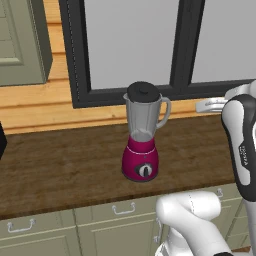
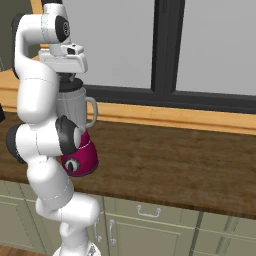
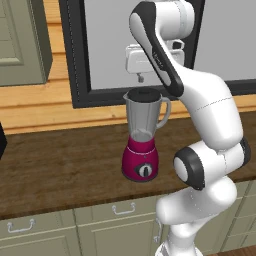
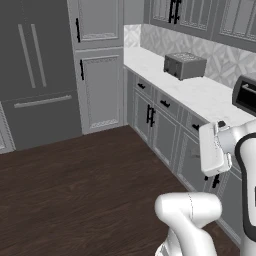
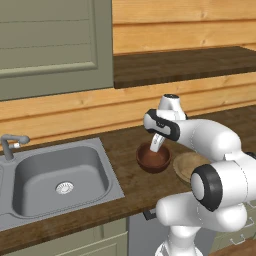
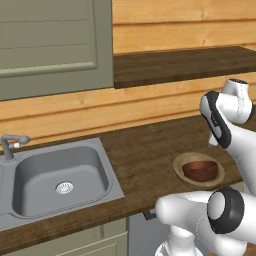
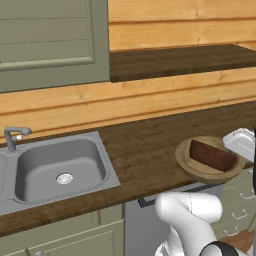
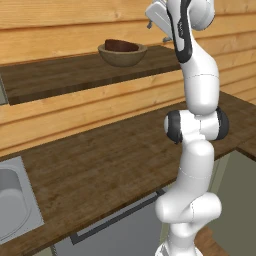
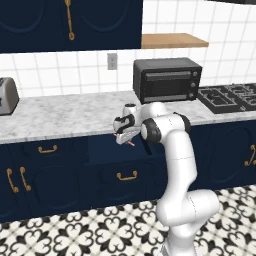
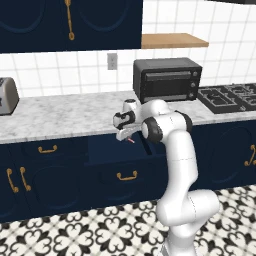
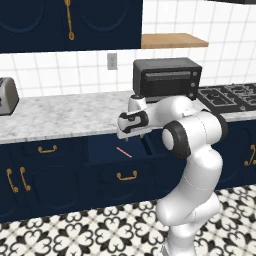
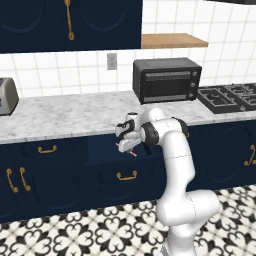
Development examples from RoboCasa365, grouped by the revision types in Fig. 4. The cases connect observed failures, recovery behavior and the resulting skill revisions. Videos run at 1×; case labels identify single-episode recoveries, separate runs on the same seed and the use of privileged diagnosis. Quantitative results are reported above.
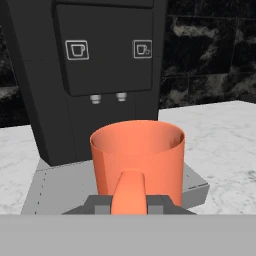
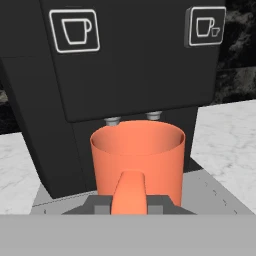
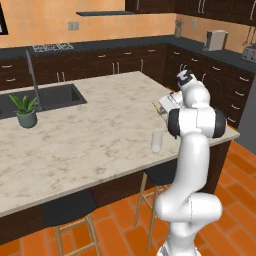 Tip misaligned with the cup
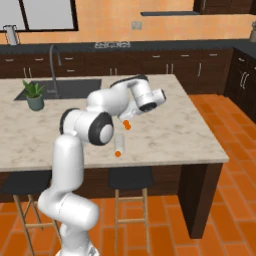 Straw and cup measured from RGB-D
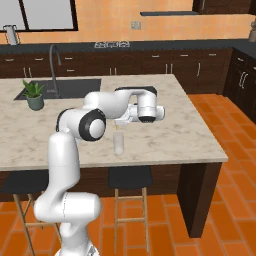 Re-observed at the computed target
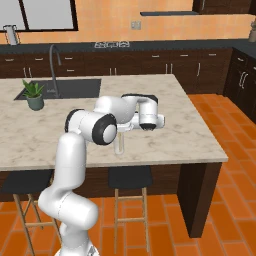 Released inside the cup
The same procedure in three forms: the rule in the skill text, the script it points to, and the call the agent actually made in the episode above. The text is verbatim.
constrained-insertionInsert an observed held object through a visible opening or into a constrained receptacle, using fresh geometry and observable containment checks.
The geometry.py helper computes an axis-alignment rotation and TCP target from two currently observed held-segment points, the current TCP pose, and a desired free-end point. Choose the point order from the visible free end; the result is not a perception estimate. This corrects the rotated offset between the TCP and the insertion tip. Recompute after any changed grasp or base pose. Start above the opening with observed clearance, verify held identity and actual arrival, then descend in short checked segments. Support-plane points alone do not measure a transparent opening height. The helper performs no physical actions.
Contact or slip can change the observed tip-to-TCP relation even while the object remains held. If the object tilts, the grasp opening changes, or insertion stalls, stop descent, unload the contact, and refresh the visible free end and opening before realignment; do not reuse the pre-contact offset.
align_free_end() in geometry.pydef align_free_end(segment_near, segment_tip, tcp_position, tcp_quaternion_xyzw,
tip_goal, target_axis=(0., 0., -1.)):
"""Rotate the measured free-end axis and offset to a caller-chosen goal.
Points use one current world frame in metres; quaternion order is XYZW.
The caller establishes point identity, opening clearance and freshness.
Unknown/degenerate inputs raise ValueError and produce no motion target.
"""
near = _finite_vector(segment_near, 3, "segment_near")
tip = _finite_vector(segment_tip, 3, "segment_tip")
tcp = _finite_vector(tcp_position, 3, "tcp_position")
goal = _finite_vector(tip_goal, 3, "tip_goal")
axis = tip - near
length = np.linalg.norm(axis)
if not np.isfinite(length) or length < .005:
raise ValueError("Observed segment is too short or unresolved")
u = axis / length
v = _finite_vector(target_axis, 3, "target_axis")
norm = np.linalg.norm(v)
if not np.isfinite(norm) or norm <= 1e-12:
raise ValueError("target_axis must be nonzero")
v = v / norm
q = _finite_vector(tcp_quaternion_xyzw, 4, "tcp_quaternion_xyzw")
norm = np.linalg.norm(q)
if not np.isfinite(norm) or norm <= 1e-12:
raise ValueError("tcp_quaternion_xyzw must be nonzero")
q = q / norm
cross = np.cross(u, v)
dot = np.clip(np.dot(u, v), -1., 1.)
if dot < -1. + 1e-8:
basis = np.eye(3)[np.argmin(np.abs(u))]
a = np.cross(u, basis)
a /= np.linalg.norm(a)
delta = np.r_[a, 0.]
else:
delta = np.r_[cross, 1. + dot]
delta /= np.linalg.norm(delta)
a, w = delta[:3], delta[3]
offset = tip - tcp
rotated_offset = offset + 2 * np.cross(a, np.cross(a, offset) + w * offset)
b, z = q[:3], q[3]
newq = np.r_[w*b + z*a + np.cross(a, b), w*z - np.dot(a, b)]
target = goal - rotated_offset
if not np.isfinite(target).all() or not np.isfinite(newq).all():
raise ValueError("Input geometry did not produce a finite target")
return {"position": target.tolist(), "quaternion_xyzw": newq.tolist(),
"quaternion_wxyz": np.r_[newq[3], newq[:3]].tolist(),
"segment_length_m": float(length), "tip_goal": goal.tolist()}| Field | Value | Meaning |
|---|---|---|
segment_near | (3.833, -3.411, 1.140) | observed straw point, back-projected from pixel (126, 123) |
segment_tip | (3.844, -3.414, 1.114) | observed free tip, from pixel (128, 127) |
tcp_position | (3.798, -3.397, 1.188) | current TCP |
tip_goal | (3.779, -3.425, 1.114) | XY above the observed cup; Z = current raised tip height |
→ position | (3.765, -3.417, 1.202) | returned TCP target |
→ quaternion_xyzw | (0.447, -0.607, -0.507, 0.418) | returned TCP orientation (tip axis → downward) |
→ segment_length_m | 0.0285 | length of the measured segment |
As recorded with the call: the goal height is the currently observed raised tip height, not a measured cup-opening height, so the result is an above-cup alignment target rather than a release target. The agent then solved IK, executed the joint target, switched back to OSC, descended in checked segments and re-observed before releasing.
Full files (verbatim)
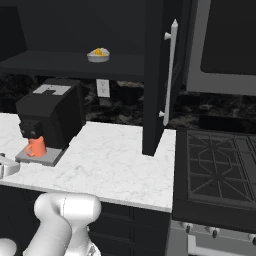
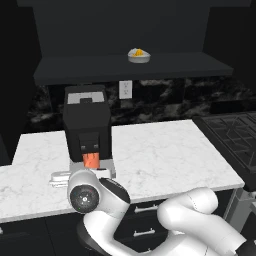
Privileged simulation state informed the diagnosis. The resulting grasping rule was used in a follow-up development trial.
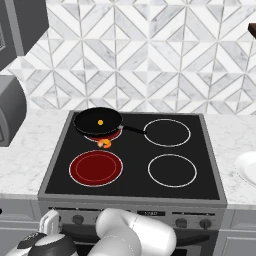
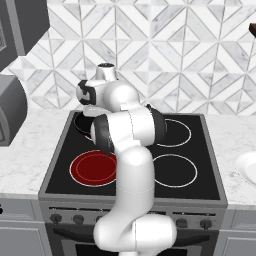
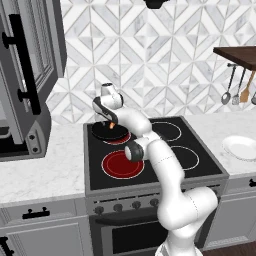
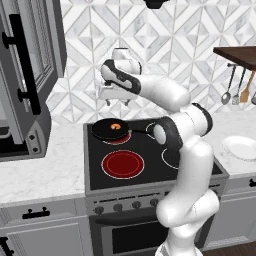
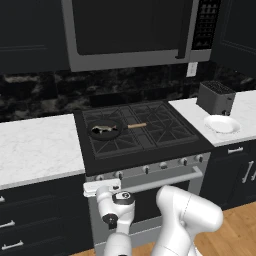 Approach the knob
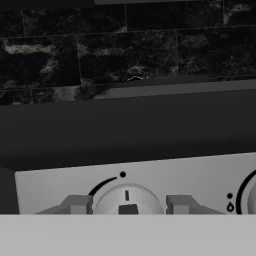 First close hits the fixed base
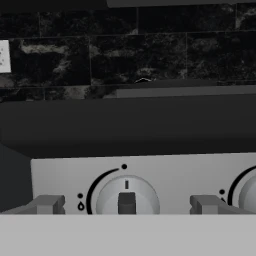 Open and reduce the depth
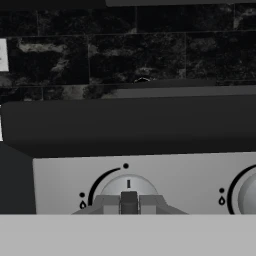 Close on the movable ridge
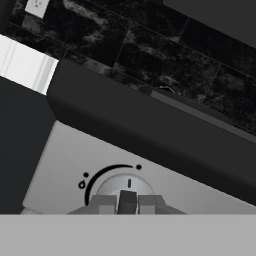 Small turn, check progress
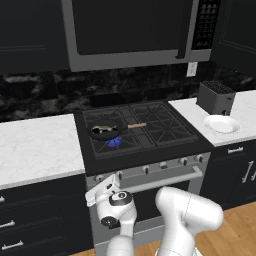 Burner lit, task success
The two clips are different episodes on the same seed; privileged diagnosis was used between the two runs.
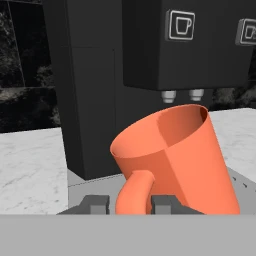 Earlier run: mug tipped at the tray edge
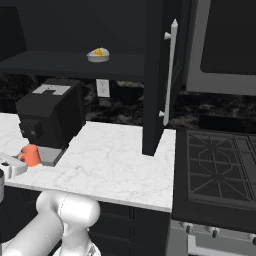 Later run: upright but blocked by the rim
 Lift 8 mm to clear the rim
 Align by the mug body
 Released, mug stands on its own
 Task success
estimate_assembly_geometry (plane fit, tilt and cross-view consistency of a selected region) and compare_assembly_states (response of the object to a short action), and a skill that specifies when to measure, short-lift, re-check, and hand back to VLA.The recovery shown uses only ordinary RGB-D observations; its measurements and checks informed the resulting skill and scripts.
 Lid unseated after VLA placement
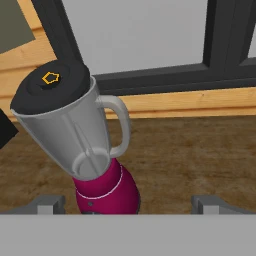 Lid plane fitted from RGB-D
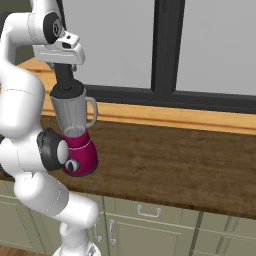 Re-approach the central grip
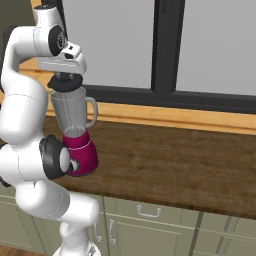 Re-grasp, short lift, re-observe
 Adjust pose, lower in segments
 Released, task success
Recorded motion at 1× with paused holds that show each actual tool call, its logged inputs and outputs, and the rule later written into the skill.
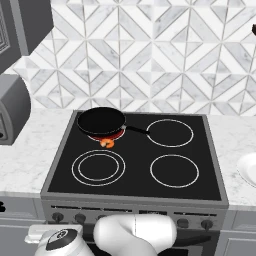 Shrimp left outside the pan
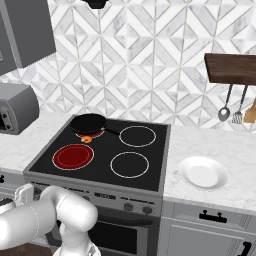 Still outside after a retry
 RGB-D points on shrimp and pan
 Grasp verified by a short lift
 Lowered and released in the pan
 Task success
The routing rule written after the development episode above (excerpt, verbatim).
2. Compare current relations with the previous checkpoint. Two checkpoints showing the same missing relation trigger at most one 400-step recovery prompt for that relation. Preserve complete task context; add only directly observed state and a concrete correction. The intended food destination is the pan interior. Do not assert held state from proximity or infer the enabled burner solely from color.
3. If the correction fails and food is visibly released outside a reachable pan on an open surface, use current-view pixel backprojection for food and pan interior. Apply the generic pick-place gates: unobstructed approach, close, short-lift hold verification, transport, fresh destination check as needed, lower, release, retreat. Allow at most two grasp attempts with changed current geometry and at most 600 physical recovery steps per episode. Include calibration steps in accounting.
 Earlier run: carried off the counter
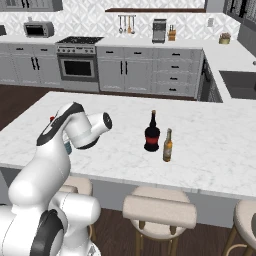 First VLA transport heads the wrong way
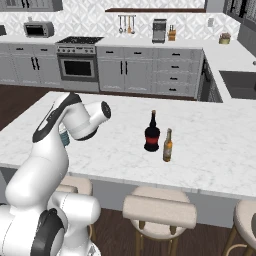 Grasp kept, checked by a short lift
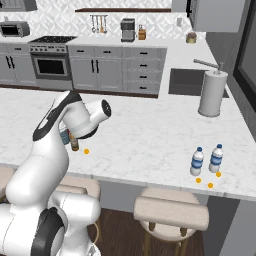 Target group and bottle measured
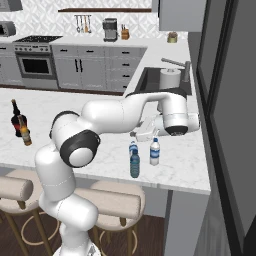 Released at the correct group
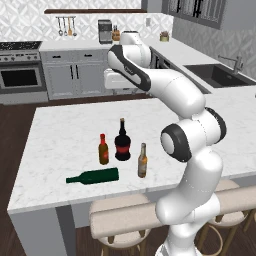 Task success
The recovery trial used a fresh agent context and ordinary observations.
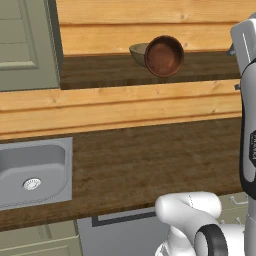 Failed run: small bowl on the rim
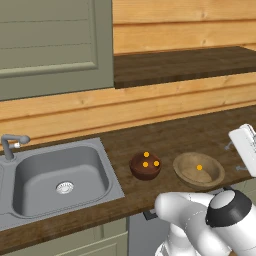 RGB-D point on the small bowl
 Side-rim grasp, lift to verify
 Nested at the source
 Both bowls lifted together
 Placed in the cabinet
Rule text used in the recovery trial above (verbatim excerpt).
When a goal combines containment and transport, test the source-assembly motif from observable_subgoal_sequence.md when its current visual and reachability preconditions hold. Verify stable assembly before transporting the composite. If those preconditions do not hold, choose a different ordering from current evidence.
Check the requested object-object relation separately from placement at the destination. Parallel placement, a vertical object leaning on a rim, or an object moving with an allegedly released gripper requires recovery. Stop blind continuation when the base drifts away from a local unresolved relation. Re-localize first.
Privileged simulation state located the first physical failure; the rule was written into the skill after this episode.
 Short lift, grasp holds
 Further lift hits the counter
 Grasp lost, rod falls back
 Re-grasp, keep low
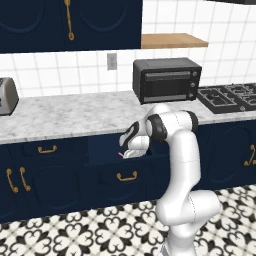 Exit past the overhang
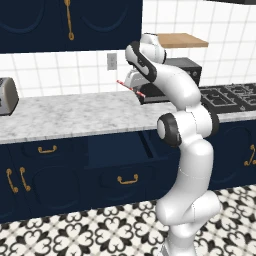 Lifted, still held
No continuous recording of these runs is available, so this case is shown with still frames.
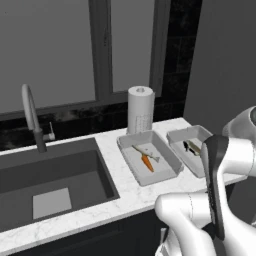 VLA-only: carrots gathered in one box
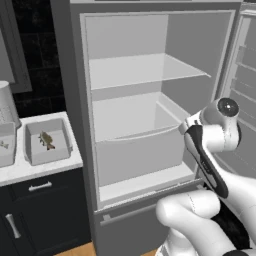 VLA-only: ends at the empty fridge
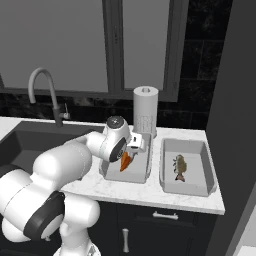 Updated run: two carrots share a box
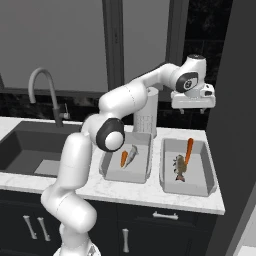 One carrot moved, one per box
On a Franka arm with a two-finger soft gripper, the frozen simulation library initializes the real-robot agent, whose skills are subsequently revised from real-world execution experience through the same exploration, diagnosis and validation loop. Real-world execution uses SAM3 segmentation, YOLO-World detection, AnyGrasp grasp generation, CuRobo motion planning, low-level control, and the frozen VLA (our trained π0.5-based policy) and Tether policies. Comparisons hold agent configuration, policy checkpoints, tool implementations, camera access and execution constraints fixed. Skills are updated only between development episodes; evaluation keeps the library frozen and allows replanning and recovery within an episode.
We compare evolution from an empty library (w/o Sim) with evolution initialized from the frozen simulation library (w/ Sim). The evaluation comprises 3 tasks with related procedures in the simulation library: moving a plate from a rack to a mat, inserting a straw into a cup, and transferring a fried egg from a pan onto a plate. Development is capped at 150 M total tokens per task. We measure attempts and cumulative output and total token counts until the first complete success, then freeze the resulting library and evaluate it in 5 independent trials with different initial layouts.
| Task | Attempts ↓ | Output tokens (M) ↓ | Total tokens (M) ↓ | Success rate ↑ | ||||
|---|---|---|---|---|---|---|---|---|
| w/o Sim | w/ Sim | w/o Sim | w/ Sim | w/o Sim | w/ Sim | w/o Sim | w/ Sim | |
| Move plate from rack to mat | 4 | 1 | 0.278 | 0.060 | 103.45 | 17.58 | 3/5 | 4/5 |
| Insert straw into cup | 2 | 1 | 0.088 | 0.069 | 22.21 | 34.65 | 2/5 | 5/5 |
| Transfer fried egg from pan onto plate | 2 | 1 | 0.191 | 0.074 | 85.34 | 24.64 | 1/5 | 4/5 |
Simulation initialization reduces development attempts on all three tasks. Each task reaches its first complete success in one attempt, compared with 4, 2 and 2 attempts without simulation initialization for plate transfer, straw insertion and fried egg transfer, respectively. The benefit extends to subsequent frozen execution: success counts increase from 3/5 to 4/5, from 2/5 to 5/5, and from 1/5 to 4/5.
The acquisition benefit depends on the cost metric. Simulation initialization reduces output-token consumption on all three tasks, but total-token costs vary. Plate transfer decreases from 103.45 M to 17.58 M total tokens, and fried egg transfer from 85.34 M to 24.64 M. For straw insertion, total-token consumption increases from 22.21 M to 34.65 M despite requiring fewer attempts. Thus, fewer development attempts do not always translate into lower total-token cost.
Clips are qualitative development examples, shown at 2× speed.
Baseline · w/o Sim
Approach, grasp and failed lift · 2×EvoTER · w/ Sim
Grasp, transfer and release · 2×Both development clips use the same orange plate, rack, mat and fixed camera.
Visual challenge. The transparent cup and thin, transparent straw have faint boundaries against the background, making the cup rim and straw tip difficult to localize. The agent needs to align the straw with the opening and verify that it remains inside after release.
Baseline · w/o Sim
Insertion and release fail · 2×EvoTER · w/ Sim
Insertion, release and withdrawal succeed · 2×The clips show transparent cups and straws from the same fixed-camera view; object positions and background items differ.
Baseline · w/o Sim
Approach, lift, transfer and missed pour · 2×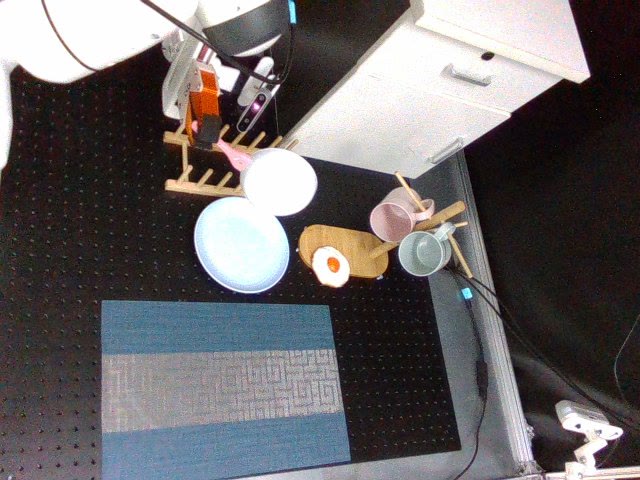 Final observation · alternate fixed camera
EvoTER · w/ Sim
Grasp, transfer and pour · 2×The baseline video shows approach, pan lift, transfer and pouring motions from the same failed episode as the final observation.
To assess the contribution of real-world feedback to long-horizon execution, we compare Direct transfer with Real-world evolution on table setting, drawer storage and two-cup hanging. Table setting arranges a plate, bowl and spoon, with later placements accounting for the actual plate and bowl positions. Drawer storage requires opening the drawer before placing a tissue packet inside. Two-cup hanging requires hanging both cups on a rack and examines how the skill library develops procedures beyond those acquired in simulation. For this task, Tether provides the hanging capability and is available to both conditions before comparison, with its implementation fixed. Both conditions start from the same frozen simulation library, independently of short-horizon development. Direct transfer keeps the library unchanged, whereas Real-world evolution revises its tool-use procedures through real-world development before freezing. Both permit observation, replanning and recovery per test episode under the same execution budget, without library updates between test episodes. Success requires all task-specific goal relations to hold at episode end. Long-horizon evolution from an empty library is not evaluated within the real-robot development budget.

Real-world experience refines execution procedures. Following real-world evolution, the agent completes table setting in 4/5 trials, drawer storage in 5/5 trials, and two-cup hanging in 5/5 trials, compared with 1/5 on each task under direct transfer. For table setting under direct transfer, the five trials complete 4, 0, 6, 4, 0 of six stages, respectively, yielding mean stage progress of 100 × 14/30 ≈ 46.7. The revisions illustrate how real-world experience updates both state-dependent manipulation rules and procedures for invoking newly available tools. For example, a revised table-setting rule computes the spoon release height from the current bowl geometry and held-spoon pose.
Tether warps a demonstration trajectory using visually matched grasp and release references and executes it open-loop. Native invocations repeatedly failed because the matched references deviated from the intended actions. After diagnosing these failures and receiving a high-level hint to select the references itself, the agent evolved a skill that selects them from the observed cup, handle and rack and revises those rejected by cross-view triangulation, while Tether remains unchanged.
Long-horizon task demonstrations at 2× speed. See Tether Case Studies for comparisons of native and skill-guided references.
Native Tether matches grasp and release references automatically. The evolved skill selects and checks them across views of the current scene, using the same Tether trajectory warping and execution.
The target sits behind a blue cup already on the rack. Native matching leads the approach into the blue cup; agent-selected references allow the pink cup to be grasped and hung.
Both trials lift the blue cup. In the native trial it falls onto the table at release; with agent-selected references it remains hanging after the gripper withdraws.
The pink cup starts farther left on the board than in the first pair. Native Tether misses the grasp and continues empty-handed; the agent selects new references from the current scene and completes the hang.
Comparisons use separate trials with scene resets between conditions. The pink-cup pairs are development demonstrations; the blue-cup pair compares native and skill-guided reference selection using the same demonstration. All clips show the complete recorded action window at 2× speed from the same camera view.
Two additional executions with agent-selected references: a target among extra cups, and transfer of a pink-cup demonstration to a gray cup.
These two trials illustrate additional successful transfers; matching native trials in these cluttered layouts are not included. The neighboring blue cup changes angle in both executions. Quantitative evaluation remains as reported in Real-World Transfer and Evolution.
@article{evoter2026,
  title   = {EvoTER: Evolving Embodied Agents via Tool-Use Experience and Reflection},
  author  = {Anonymous Authors},
  journal = {Under review},
  year    = {2026}
}